
What Is AI Home Staging and How Can It Help You Sell Faster?

Picture an empty living room at golden hour, the floor pale and the walls a quiet eggshell. A buyer scrolling on a phone sees only proportions, not possibility. AI home staging changes that frame: it digitally furnishes the photograph in seconds, layering sofas, rugs, and warm lamplight into the bare shell so the room *reads* as a home. Tools like AI Renovation make that shift available to any seller, agent, or photographer trying to reach a market-ready listing without renting a truck full of furniture.
Definition: What Is AI Home Staging?

AI home staging is the use of computer vision and generative models to analyze a room's layout, light, and dimensions, then place photorealistic furniture and decor directly into the photograph. The output is a listing image that looks furnished, while the underlying property remains untouched. The category sits alongside other AI-assisted interior visualization workflows that real estate professionals increasingly rely on.
In plain English: it is a one-click way to show a room dressed for sale, without dressing the room.
How It Differs from Traditional and Virtual Staging
Traditional physical staging means rented furniture, a stylist, and an installation day. Costs typically run into the thousands. Earlier "virtual" staging meant a human designer in Photoshop, with a brief, revisions, and a turnaround measured in days. AI staging compresses that loop into seconds. A platform built for vacant-room transformations can return a finished image in roughly the time it takes to refill a coffee.
The Technology Behind It
Under the hood, computer vision maps the room's geometry, while generative diffusion models render furniture that respects the original perspective, scale, and lighting. The same family of models powers broader AI-driven home design tools that handle renovations and exteriors. Mainstream adoption is now visible at the marketplace level: Zillow's September 2025 launch of AI-powered Virtual Staging inside Showcase, built on its 2024 acquisition of Virtual Staging AI, signals that the technology has crossed from novelty into infrastructure.
Takeaway: AI staging is not a faster designer. It is a different production model entirely, built on vision models that read the room before they furnish it.
How AI Home Staging Works: The Step-by-Step Process

The workflow is unusually short. Most platforms collapse the work into three movements, and a creator-facing staging canvas follows the same rhythm.
Uploading and Analyzing the Photo
The first step is the upload. Professional tools accept RAW, JPG, PNG, and HEIC files up to around 50MB, which means a photographer's existing capture pipeline doesn't need to change. The AI then reads the geometry of the room, identifying floor planes, walls, windows, and the direction of natural light. A general-purpose home design utility performs a similar analysis before suggesting any visual change.
Choosing Style and Room Type
Next comes the editorial decision. The user selects a room type, living room, bedroom, kitchen, dining, exterior, then a design style. Leading platforms offer modern, Scandinavian, industrial, midcentury, luxury, coastal, and farmhouse, among others. Agents marketing a beach cottage and a downtown loft can pull from the same interior style library and target very different buyers without commissioning two separate photoshoots.
Generating and Downloading Results
The render itself usually arrives in 15 to 30 seconds. Most tools allow unlimited regenerations, so an agent can ask for a different sofa arrangement or a warmer palette without paying for a second design pass. Many platforms also handle furnished rooms, swapping existing furniture for a new arrangement or clearing the space entirely. A separate furniture generator can then dress the room in something specific if the default library feels off.
Takeaway: three steps, under a minute, and the output drops straight into a listing or social post.
Why It Matters: The Impact on Buyer Interest and Sale Outcomes

Staging works because most buyers cannot read an empty room. The numbers around that limitation are well documented, and the broader case for visualization sits at the heart of why AI staging spread so quickly.
Buyer Psychology and Visualization
According to the National Association of Realtors, 83% of buyers' agents report that staging makes it easier for buyers to picture a property as their future home. An empty room asks the viewer to do the imaginative work; a staged room offers a finished mental picture. The same logic drives demand for adjacent visualization formats like AI-generated home renderings that show finished interiors before any work begins.
Quantified Impact on Speed and Price
Collov AI's product documentation cites that virtually staged homes can sell up to 73% faster and attract 78% more qualified buyers, with staged properties commanding up to 20% higher offers. Zillow's 2024 Consumer Housing Trends Report adds that 71% of sellers are more likely to hire an agent who uses interactive media such as virtual tours or floor plans. Zillow's own data on Showcase listings, reported in its September 2025 announcement, shows Showcase agents winning 30% more listings and Showcase homes selling for $7,000 more on average. Agents tracking these numbers often pair staged photos with exterior visualizations to give a complete first impression.
Takeaway: the speed and price effect is large, well-cited, and now visible in marketplace-level data, not just vendor case studies.
Common Misconceptions About AI Home Staging
The category attracts a recurring set of doubts. Most fade once the underlying mechanics are clear, as the feature documentation for AI home staging lays out.
Misconception: AI Staging Is Misleading or Not MLS Compliant
Reality: leading platforms preserve the actual room layout and dimensions and do not alter structural elements. Standard practice is to disclose that photos are digitally staged, and the major listing portals accept those disclosures. The home itself is never changed; only the furniture in the frame is.
Misconception: Results Look Fake or Obviously Digital
Reality: modern models are trained on spatial depth and lighting cues, so furniture sits on the floor rather than floating above it, and shadows fall in the right direction. The same depth-aware approach shows up in adjacent tools such as an AI bathroom design generator, where realism matters just as much.
Misconception: It Only Works for Empty Rooms
Reality: furnished rooms are fully supported. Tools can remove existing furniture, declutter a space, or restyle around what is already there. An agent re-marketing a tired rental can run the photos through an AI remodel workflow and present a meaningfully different listing without touching the property.
Takeaway: the legitimate concerns are about disclosure and craft, not about whether the technology is honest or capable.
AI Home Staging vs. Physical Staging: A Feature Comparison
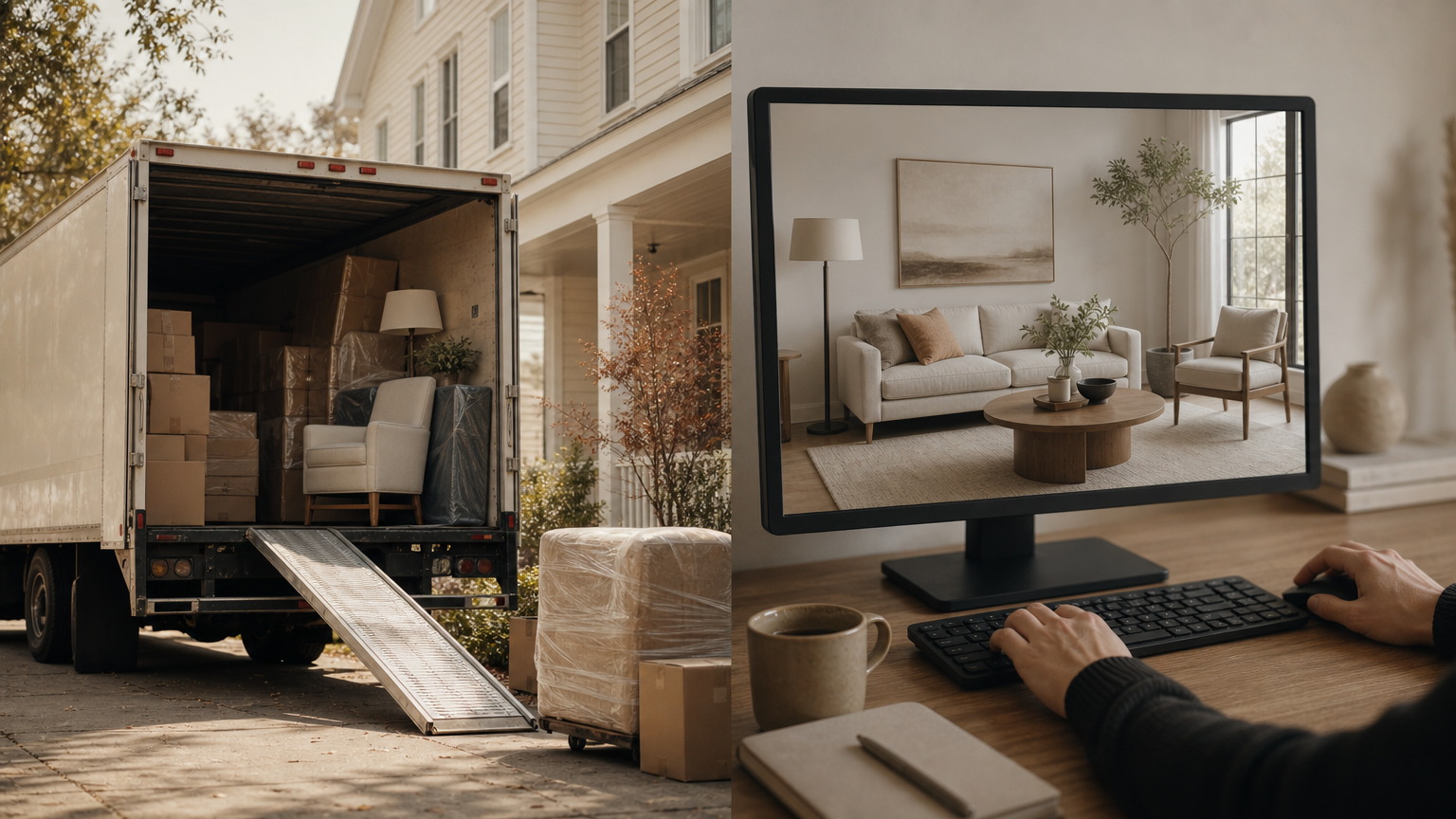
The two approaches answer different questions. The comparison below, drawn from public vendor pricing and standard staging industry figures, sets them side by side; an AI renovation pricing page shows where the digital end of the market sits today.
| Factor | AI Home Staging | Physical Staging |
|---|---|---|
| Typical cost | From ~$16/month for multiple images | $1,500 to $5,000+ per listing |
| Turnaround | 15 to 30 seconds | Several days |
| Style options | 7+ curated styles, unlimited regenerations | Limited to inventory on hand |
| Best for | Vacant homes, online-first buyers, high listing volume | Luxury listings, in-person showings |
| Disclosure | Required (digital edit) | Not required |
| Scalability | Effectively unlimited | Constrained by warehouse and crew |
Cost and Time Differences
The cost gap is the obvious one, but the time gap matters more for active listings. A property that goes live on Monday with staged photos pulls inquiries the same week; a physical install on Friday means missing the first weekend of search traffic. For agents managing portfolios, the enterprise tier tends to be where AI staging stops being a per-listing decision and becomes a default.
When Physical Staging Still Makes Sense
Physical staging still earns its place for luxury homes where in-person showings dominate and tactile materials, the weight of a chair, the feel of a rug, shape the offer. A hybrid pattern is increasingly common: AI staging for the online listing, a light physical touch for open-house day. A quick browse through recent renovation case studies shows how digital visualization sits comfortably next to real-world finishes.
Takeaway: AI staging is the new default for online marketing; physical staging is the specialist tool for high-touch sales.
How to Choose the Right AI Home Staging Tool
Tools in this category look similar at a glance. The differences become real once you stage a few rooms. A short visit to an AI app for house design or a comparable platform usually reveals where it shines.
Key Features to Evaluate
The features worth weighing:
- Turnaround speed under 30 seconds is now standard
- Style breadth at least seven core styles, plus regeneration
- Furnished-room support including furniture removal
- Output resolution MLS-ready files, ideally from RAW input
- Adjacent editing sky replacement, day-to-dusk, lawn enhancement, object removal
- Floor plan and structural tools such as an AI floor plan generator for listings that need more than staging
Pricing and Scalability Considerations
Pricing splits three ways: per-image (good for occasional sellers), monthly subscriptions (the sweet spot for working agents), and enterprise or API tiers (for brokerages and media platforms). Batch processing is the quiet feature that matters at scale; staging fifty listings one at a time is a different job from staging fifty in a single pipeline. The explore gallery is a useful place to see what consistent batch output actually looks like before committing to a plan.
Takeaway: match the pricing model to your volume, and prioritize tools whose output drops cleanly into your existing media workflow.
Frequently Asked Questions
What is AI home staging?
AI home staging uses generative artificial intelligence to digitally furnish property photos. It analyzes the room's layout and lighting, then renders photorealistic furniture and decor into the image, producing a staged listing photo in seconds.
How much does AI virtual staging cost?
Subscriptions for AI virtual staging start around $16 per month for several images, with per-image pricing available for occasional use. Physical staging, by comparison, typically runs $1,500 to $5,000 or more per listing depending on home size.
Is AI virtual staging MLS compliant?
Yes, when used responsibly. Leading platforms preserve the actual room layout and structural elements, and standard practice is to disclose that listing photos are digitally staged. Most major MLS systems and portals accept properly disclosed virtually staged images.
How long does AI home staging take?
Most platforms return a finished, photorealistic staged image in 15 to 30 seconds per photo. Many also offer unlimited regenerations, so requesting an alternate arrangement or design style adds only another few seconds rather than a new design cycle.
Does AI staging work on furnished rooms or only empty ones?
Both. Modern AI staging tools support furnished rooms by removing existing furniture, decluttering, or restyling around current pieces. Zillow's Virtual Staging feature, for example, can clear a room entirely so shoppers see the space as a blank slate.
Can AI home staging really help a home sell faster?
Industry figures suggest yes. Vendor documentation reports staged homes selling up to 73% faster with 78% more qualified buyers, and 83% of buyers' agents tell the National Association of Realtors that staging helps buyers visualize a property as their future home.
What design styles are available with AI virtual staging?
Most platforms offer modern, Scandinavian, industrial, midcentury, luxury, coastal, and farmhouse, often with additional options like Japandi, boho chic, and rustic farmhouse. Agents can target different buyer demographics by restaging the same room in multiple styles.
What is the difference between AI virtual staging and traditional virtual staging?
Traditional virtual staging relies on a human designer working in Photoshop, with a brief and multi-day turnaround. AI virtual staging generates the same result automatically in seconds, with unlimited regenerations and no design brief required.
A Quieter Path to a Market-Ready Listing
Selling a home is, in the end, about helping someone *picture themselves there*: morning coffee at a kitchen island, a reading chair angled toward the window, a quiet evening light. AI staging shortens the distance between an empty photograph and that feeling. For sellers and agents weighing the next listing, the AI Renovation platform is one place to see what a few seconds of computer vision can do to a room, and to the buyers scrolling past it.
Drafted by an AI blog writer and edited before publishing.
Ready to get started? Try our Redecorate Room, or Design Your Own Rooms.